Text
Zakaat al-Fitr
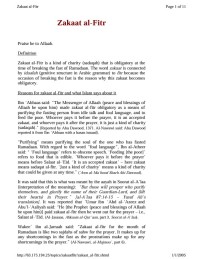
The document outlines the underlying purpose and wisdom behind this prescription, citing the authentic narration of Ibn 'Abbaas (reported by Abu Dawood, 1371). Zakaat al-Fitr serves two primary purposes: purifying the soul of the fasting person from shortcomings such as idle talk and foul or obscene language, and providing food to sustain the poor. Furthermore, the text emphasizes the strict timing of the obligation: if paid before the Eid prayer (Salaat al-'Eid), it is considered an accepted zakaat, whereas if it is paid after the prayer, it diminishes to an ordinary act of voluntary charity. The chapter also references textual interpretations of Surah al-A'laa (verses 14–15) and highlights a profound analogy by Wakee' ibn al-Jarraah, who likened Zakaat al-Fitr for the month of Ramadan to the two prostrations of forgetfulness (sajdahs of sahw) in prayer, as it effectively compensates for any shortcomings committed during the fast.
Click here!
Detail Information
- Call Number
-
297.54 ZAK z
- Publisher
- : ., 2005
- Collation
-
11 p. ; 30 cm. PDF e-book.
- Language
-
English
- ISBN/ISSN
-
-
- Classification
-
297
- Subject(s)
Other version/related
No other version available
 Computer Science, Information & General Works
  Philosophy & Psychology
  Religion
  Social Sciences
  Language
  Pure Science
  Applied Sciences
  Art & Recreation
  Literature
  History & Geography